Power Supply Efficiency Explained — Why Every Watt Matters | ARCH
When selecting a switching power supply, engineers often focus on voltage, current, and reliability. However, one critical parameter is sometimes overlooked: efficiency. Power efficiency not only affects energy consumption but also directly impacts thermal management, system lifetime, and compliance with modern environmental standards. Learn from ARCH power supply blog articles on AC-DC design, EMC, safety standards and application tips that help engineers choose reliable power modules faster.
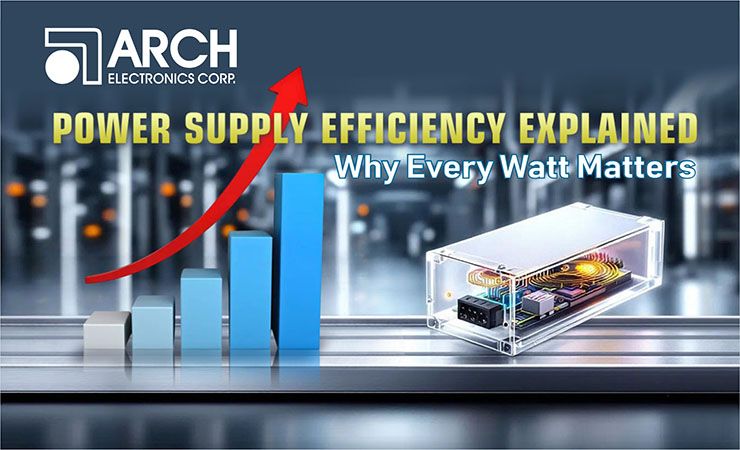
Power Supply Efficiency Explained — Why Every Watt Matters
When selecting a switching power supply, engineers often focus on voltage, current, and reliability. However, one critical parameter is sometimes overlooked: efficiency. Power efficiency not only affects energy consumption but also directly impacts thermal management, system lifetime, and compliance with modern environmental standards.
What is Power Efficiency?
Power efficiency is defined as the ratio of output power to input power:
Efficiency =
Pout
Pin
× 100%
Where:
Pin:Input Power
Pout:Output Power
For example, if a power supply draws 100W from the mains and delivers 90W to the load, its efficiency is 90%. The remaining 10W is lost as heat.
Why Efficiency Matters
- Lower Energy Consumption
Higher efficiency means less wasted power, reducing operating costs. - Reduced Heat Generation
Less energy lost as heat improves stability and simplifies thermal design. - Extended Lifetime
Lower operating temperatures slow down component aging, prolonging product lifespan. - Smaller Footprint
High efficiency allows for more compact system designs with less need for heat dissipation. - Regulatory Compliance
Global efficiency standards (e.g., Energy Star, ErP, DOE) require power supplies to meet minimum efficiency thresholds.
Efficiency as a Market Trend
Efficiency has become a key benchmark not only for technical design but also for environmental impact and sustainability. If ignored, the results include higher energy costs, excessive heat, shorter product lifespan, and even the inability to access regulated markets.
Typical Efficiency Ranges in Power Supplies
- Linear Power Supplies: ~50–60%
- Conventional Switching Power Supplies: 75–85%
- Modern High-Efficiency Designs: 90–95%
- Best-in-Class Architectures: >96% in certain topologies
Key Factors Affecting Efficiency
- Topology Choice (e.g., Flyback, Forward, Resonant)
- Component Quality (MOSFETs, magnetic cores, capacitors)
- Thermal Design (cooling method, PCB layout)
- Load Conditions (light-load vs. full-load efficiency differences)
Applications Where Efficiency Matters
- Industrial Automation — Controllers and sensors running continuously
- Medical Equipment — Systems where low heat and reliability are critical
- Financial Terminals — ATMs and kiosks operating 24/7
- Entertainment Systems — Slot machines requiring stable, efficient operation
Conclusion
Efficiency is more than just a number on a datasheet — it is a core indicator of energy savings, system reliability, product longevity, and regulatory compliance. As industries move toward greener and more sustainable designs, choosing a high-efficiency power supply has become an essential engineering priority. At ARCH, multiple product families already deliver outstanding efficiency performance, helping customers design safer, greener, and more reliable systems.
- Related Products
Power Supply Efficiency Explained — Why Every Watt Matters | ARCH
The ARCH power supply blog shares practical guides on AC/DC design, EMC, safety approvals and thermal performance for real-world industrial and medical projects.
Each article is written for hardware engineers, project managers and buyers who need clear, vendor-backed explanations rather than generic theory.
Browse our latest posts to compare architectures, avoid common design mistakes and make more confident sourcing decisions for your next power platform.
Our Company Facts in Numbers
0
Years of Experience
0
Global Customers
0
Countries
0%
R&D Staff