Technical Feature|In-Depth Analysis of Power Protection Mechanisms — OVP / OCP / OPP / OTP / SCP | ARCH
In industrial control, communication, medical, and energy applications, a stable and reliable power supply is the heart of system operation. Under harsh environments, a power module must not only deliver power but also protect itself. Therefore, ARCH Electronics power supplies are designed with multiple Protection Functions, capable of detecting and preventing abnormal conditions such as input voltage fluctuations, overload, or temperature rise — safeguarding both the power supply and the system load. Learn from ARCH power supply blog articles on AC-DC design, EMC, safety standards and application tips that help engineers choose reliable power modules faster.
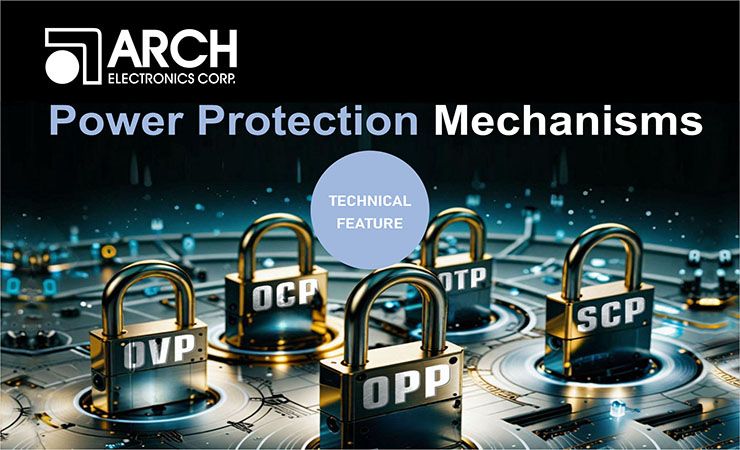
Technical Feature|In-Depth Analysis of Power Protection Mechanisms — OVP / OCP / OPP / OTP / SCP
In industrial control, communication, medical, and energy applications, a stable and reliable power supply is the heart of system operation. Under harsh environments, a power module must not only deliver power but also protect itself. Therefore, ARCH Electronics power supplies are designed with multiple Protection Functions, capable of detecting and preventing abnormal conditions such as input voltage fluctuations, overload, or temperature rise — safeguarding both the power supply and the system load.
OVP (Over Voltage Protection) — Prevents Output Overvoltage Damage
During AC-DC or DC-DC conversion, control circuit failure may cause the output voltage to exceed the rated level, damaging load components such as ICs, sensors, or motor controllers. OVP monitors the output voltage and shuts down or disables the output once it exceeds the preset threshold. Some models adopt a latch-off design (requiring power recycle) or auto-recovery function.
🔹 Example: In industrial automation control boards, even a brief voltage surge may destroy the control IC. A module with OVP can instantly shut down the output to protect the main board.
OCP (Over Current Protection) — Prevents Overcurrent-Induced Overheating or Damage
OCP monitors output current and limits or stops it once it exceeds a safe range. Typical control methods include:
- Constant Current Limit: Maintains a fixed current output.
- Fold-Back Limit: Gradually reduces current to minimize heat buildup.
- Hiccup Mode: Periodically turns output off and automatically restarts once the fault clears.
ARCH power products primarily adopt the “Hiccup Mode” protection method, which effectively prevents overheating and damage caused by excessive current, and automatically recovers once the fault is removed—making it ideal for long-duration industrial applications.
🔹Example: During motor startup or capacitor charging, a sudden inrush current often triggers OCP. The hiccup design prevents permanent damage and allows automatic recovery.
OPP (Over Power Protection) — Prevents Output Power from Exceeding Rated Capacity
Output power = Voltage × Current.
When excessive load causes the output power to exceed design limits, components may overheat and shorten their lifespan. OPP detects overpower conditions and either reduces output or enters protection mode. In some designs, OPP and OCP operate together to maintain safe energy levels.
🔹 Example: In multi-output power supplies, if one channel is overloaded, OPP prevents the entire system from being affected.
OTP (Over Temperature Protection) — Shields Components from Thermal Stress
At high power or in sealed environments, key components such as transformers, MOSFETs, and electrolytic capacitors can reach critical temperatures. OTP uses built-in thermal sensors (NTC / thermistors) to monitor these points. When temperature exceeds the threshold, the output is shut down or derated. The system automatically restarts once the temperature returns to normal, ensuring stable operation and component longevity.
🔹 Example: Outdoor monitoring systems, solar inverters, and robotics power supplies often rely on OTP to prevent heat-related failures in fluctuating environments.
SCP (Short Circuit Protection) — Prevents Catastrophic Damage from Short Circuits
If the output is accidentally shorted, current can surge to several times its rated value, destroying switching transistors or rectifiers. SCP detects this rapid rise within microseconds and immediately limits or cuts off output. Once the short is cleared, the power supply automatically resumes normal operation.
🔹 Example: During testing or maintenance, SCP prevents operator errors from permanently damaging the power supply.
Why Protection Mechanisms Matter
| Function | Primary Protection Target | Common Application |
| OVP | Load circuits | Sensors, controllers |
| OCP | Power supply & load | Motor startup, charging systems |
| OPP | Overall system stability | Multi-output modules, servo drives |
| OTP | Internal components | Enclosed chassis, outdoor systems |
| SCP | Entire system safety | Testing and maintenance environments |
ARCH Electronics Protection Design Philosophy
All ARCH AC-DC and DC-DC power modules are engineered with a comprehensive safety design concept:
- Each model is equipped with an optimized set of protection functions according to its power range and application type
- Certified to international safety standards (UL / IEC / EN 62368-1 or IEC 60601-1)
- Supports various recovery modes (Auto-Recovery / Latch-Off) for different system requirements
- Reinforced protection design for harsh environments — high temperature, vibration, or humidity
Whether it’s a compact low-power embedded power module or a high-power switching power supply, ARCH protection mechanisms operate silently in the background, guarding your system at all times.
Why ARCH?
ARCH’s approach to protection mechanism design goes beyond simply including standard safety functions. Our engineering philosophy is centered on system reliability and real-world application needs. By analyzing customer use cases, thermal behavior, surge patterns, and long-term reliability data, we fine-tune protection thresholds, recovery behavior, and temperature response to ensure that each protection function intervenes at the right moment, and restores normal operation smoothly and safely without requiring manual reset.
This practical and application-driven engineering mindset enables ARCH power supplies to deliver stable, reliable, and predictable performance across diverse environments—forming the most dependable foundation of your system.
- Related Products
Technical Feature|In-Depth Analysis of Power Protection Mechanisms — OVP / OCP / OPP / OTP / SCP | ARCH
The ARCH power supply blog shares practical guides on AC/DC design, EMC, safety approvals and thermal performance for real-world industrial and medical projects.
Each article is written for hardware engineers, project managers and buyers who need clear, vendor-backed explanations rather than generic theory.
Browse our latest posts to compare architectures, avoid common design mistakes and make more confident sourcing decisions for your next power platform.
Our Company Facts in Numbers
0
Years of Experience
0
Global Customers
0
Countries
0%
R&D Staff