Case Study|AFCV20 Power Module for Smart Electricity Meter Applications | ARCH
As global smart grid deployment accelerates, smart electricity meters have become essential infrastructure for advanced energy management, demand response, and remote monitoring. Learn from ARCH power supply blog articles on AC-DC design, EMC, safety standards and application tips that help engineers choose reliable power modules faster.
Case Study|AFCV20 Power Module for Smart Electricity Meter Applications
Reliable Auxiliary Power for Smart Grid Infrastructure
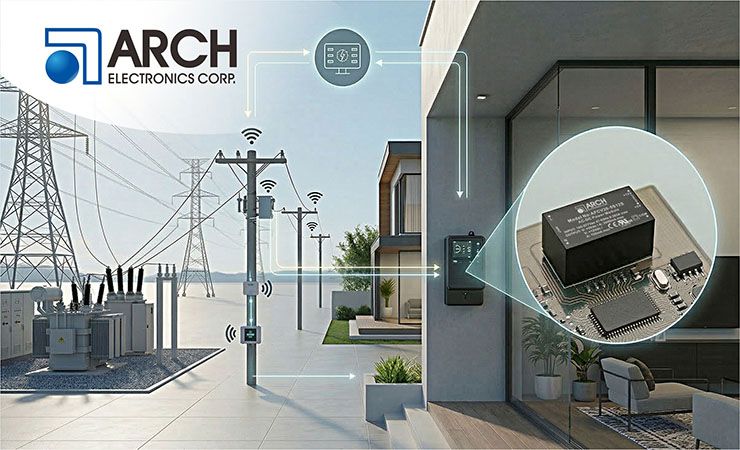
As global smart grid deployment accelerates, smart electricity meters have become essential infrastructure for advanced energy management, demand response, and remote monitoring.
Smart meters are directly connected to AC mains at the distribution level and must operate continuously under fluctuating grid conditions. Designing a reliable internal AC-DC power module is therefore critical to ensure long-term system stability, safety, and compliance.
Design Challenges in Smart Electricity Meter Systems
In real-world deployments, smart electricity meters must operate reliably under several demanding conditions:
- Continuous 24/7 operation: Power modules must provide a very high mean time between failures (MTBF) to support the long service life of smart meters, which typically operate for many years without interruption.
- High isolation and safety requirements: As smart meters are installed at the distribution level, strong insulation protection is required to ensure electrical safety.
- EMC performance for communication modules: Smart meters often integrate PLC or wireless communication modules. The power supply must provide excellent electromagnetic compatibility to prevent noise interference with measurement accuracy and data communication.
- Grid voltage fluctuation and transient events: The power module must tolerate unstable AC input conditions and withstand overvoltage environments typically present at the distribution level.
- Adaptation to harsh environments: Smart meters are frequently installed in outdoor meter enclosures and must withstand challenging environmental conditions such as high temperatures, humidity, and high-altitude installations.
Why AFCV20 is Well-Suited for Smart Meter Applications
- Wide Input Voltage Range: Designed for Global Grid Conditions
- 90–305VAC wide input: Smart electricity meters often operate under unstable grid conditions. AFCV20 supports input voltages up to 305VAC, ensuring stable operation of internal metering and communication circuits even when significant voltage fluctuations occur in the power network.
- DC input compatibility: In addition to AC input, the module also supports 120–430VDC input, providing greater design flexibility for certain DC distribution systems or specialized industrial environments.
- Class II Insulation Design: Simplified Installation with Enhanced Safety
- No protective earth required: AFCV20 features a Class II insulation design, meaning that no additional protective earth (PE) connection is required during installation. This significantly reduces installation complexity and cost, particularly in older buildings or outdoor meter boxes where grounding infrastructure may be limited.
- Enhanced protection: The reinforced insulation structure improves electrical safety while also reducing the risk of system interference caused by ground loops.
- OVC III Compliance and High Isolation Protection
- Designed for distribution-level installations: AFCV20 complies with Over-Voltage Category III (OVC III) requirements (for installations up to 2000 m altitude), providing higher tolerance to transient voltages typically present in distribution-level environments.
- 4300VAC reinforced isolation: With 4300VAC input-to-output isolation, the module effectively protects low-voltage control and data-processing circuits from high-voltage disturbances.
- Low Power Consumption and Environmental Robustness
- Ultra-low no-load power consumption: No-load power consumption is less than 0.1W, helping meet strict utility requirements for low self-consumption in metering equipment.
- Wide operating temperature range (-40°C to +85°C): Designed for harsh environments, the module maintains reliable operation in both high-temperature and cold climate conditions with an MTBF exceeding 400,000 hours.
- High-altitude capability up to 5000 m: AFCV20 supports operation at altitudes up to 5000 meters, enabling deployment of smart meters in mountainous or high-altitude regions worldwide.
Smart Meter System Integration: Flexible Dual-Output Configuration
In a typical smart electricity meter design, the internal circuitry often requires two different voltage levels:
- Metering and control circuits: Metering ICs and microcontrollers (MCUs) typically operate at 5V.
- Communication and driver modules: RF or PLC communication modules and relay driver circuits often require 12V power.
The AFCV20-5S12S dual-output configuration provides a strong integration advantage in such systems:
- Reduced component count: A single module can simultaneously provide +5V (2000mA) and +12V (833mA) outputs, replacing traditional designs that require two separate AC-DC converters or an AC-DC module combined with an additional DC-DC converter.
- Optimized space utilization: With a compact footprint of only 52.5 × 27.5 × 23.5 mm, the module delivers multiple power rails within a small form factor, helping designers save valuable PCB space and enabling more flexible meter enclosure designs.
- Improved system stability: By reducing discrete components and power conversion stages, the design can minimize electrical noise and improve overall measurement accuracy.
In system design, AFCV20 supports multiple output configurations, allowing designers to select the most suitable model to meet the power requirements of different modules.
| Application | Recommended Model | Output |
| High-current control board | AFCV20-5S | 5.1V / 4000mA |
| Communication & relay driver circuits | AFCV20-12S | 12V / 1670mA |
| Mixed-voltage system designs | AFCV20-5S12S | Dual output: 5V (2A) & 12V (0.833A) |
Application Summary
Smart electricity meters demand a compact, regulation-compliant, and highly reliable AC-DC solution.
With wide AC input capability, OVC III compliance, reinforced isolation, and ultra-low standby consumption, AFCV20 is a robust power solution for modern smart grid infrastructure.
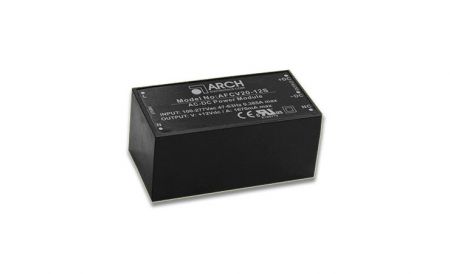
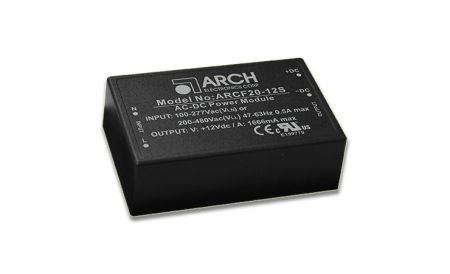
- Learn more about the AFCV20 AC-DC power module
- Related Products
Case Study|AFCV20 Power Module for Smart Electricity Meter Applications | ARCH
The ARCH power supply blog shares practical guides on AC/DC design, EMC, safety approvals and thermal performance for real-world industrial and medical projects.
Each article is written for hardware engineers, project managers and buyers who need clear, vendor-backed explanations rather than generic theory.
Browse our latest posts to compare architectures, avoid common design mistakes and make more confident sourcing decisions for your next power platform.
Our Company Facts in Numbers
0
Years of Experience
0
Global Customers
0
Countries
0%
R&D Staff